Saturday, July 21, 2012

Bead markets--Agomanya & Koforidua

On Wednesday after our bead-making workshop, the two Global Mamas interns in Krobo, Sammy and Annie, were gracious enough to invite us to go to the bead market with them, as they were headed there anyways to interview a few of the bead sellers they work with for the Global Mamas website. This proved to be an invaluable experience because not only could they help explain the difference between the types of beads (glass powder/painted/glass and old* vs. new beads), I was also able to sit in and listen to a few of the women's interviews. It was very interesting to hear the women talk about their lives--their family, education, etc.--as well as their hopes and dreams for their bead business and the greater community. The connection with the Global Mamas through the interns set us apart from other tourists and it allowed me to ask some of my own questions of the women as well.

After the market, we headed to Koforidua by tro-tro. (We were proud that we successfully made this trip as well, as we had to transfer tros in Kpong.) Thursday morning, we went to the Koforidua bead market, which is the biggest bead market in Ghana; people travel from all over the country (& some from even further) for this market. Marissa would've been in bead heaven!

A funny thing happened when we were at the Koforidua bead market. We ran into one of the Global Mamas beadsellers with whom I had talked at the Agomanya market! It was fun to run into a familiar face. Below, you can see the picture of me with Mama Rose!

* A note about old beads: old beads are antique beads that were used for during the slave trade...people would trade these beads for humans. Because they're antique and hold a lot of history, they are quite pricey. It was great to learn the difference between the two and learn to decipher between them so that I knew what I was looking at (& why some were so much more expensive than others!)

Thursday, July 19, 2012

I LOVE Global Mamas (Part 2)

Originally, I had planned to go straight from Cape Coast to Koforidua; however, we had an extra night to spend somewhere (because I wanted to be in Koforidua specifically for the big Thursday bead market). Global Mamas organizes a bead-making workshop in Krobo (which I couldn't find on a map), and because I found the other two workshops to be so worthwhile, I decided to give it a shot. The funny thing is...when we left Cape Coast, we had a vague idea of how we were getting to our destination, but not a clear plan. For an American who likes to plan things in advance, this was a wild concept--that I would just get on a tro-tro with 13 strangers and head towards Accra (about 2.5 hours) where I would somehow transfer to another station (the name/location of which I had no idea) to get on another tro-tro (for about 2 more hours) with 13 more strangers to a city I'd never heard of (we stayed in Atimpoku, a short ride from Krobo). Miraculously (to me at least), we not only made it, but we made it without any trouble. We got dropped at a random place in Atimpoku and were able to get our bearings enough to realize our hotel was only a short walk away. And, the whole trip cost us about $7 each!

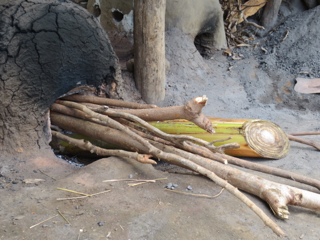
We spent Wednesday morning in Krobo learning how to make beads with Moses and his son Kwesi in their bead-making hut (photo below). Global Mamas connected with Moses because his daughter, Gladys, started with Global Mamas in production, moved up into quality control, and now is the manager of the Krobo office. Moses explained that the beads were made from glass and there are several steps. First, the glass is pounded until it's in very small pieces (you can see a pic of me doing this...it's harder than it looks and quite tiring!) Then, you sift the glass pieces so that you end up with a very fine glass powder. Next, you cut the stems of the cassava leaves to fit in the holes if the clay bead molds (these stems later burn away and leave the holes of the beads). You then select your color and mix a powdered dye into the glass powder. Then you fill the molds with the powder and pound them on the table to get rid of excess powder. The molds are now ready to go in the kiln. (I felt extremely spoiled to have an electric kiln at school after seeing Moses's hand-built outdoor wood-burning kiln that he uses daily, photos below). A very long spatula is used to put the molds in (kiln is too hot to get close to it!) and after about 5 minutes, Moses "fired it," meaning he stuffed the back with new logs, causing the fire to burn with more intensity and at a higher temperature. Twenty to twenty-five minutes later, Moses checked on the beads and saw they were shiny, which is his indicator that they're done. After cooling for a while on the ground, we rinsed the beads and strung them on elastic string. Though simple, we're very proud of our handmade beads! There are photos of the steps below...again, sorry that they're all out of order. This blogger app isn't the most useful when it comes to photos!

Thanks to a great idea given to me by a parent at my school (thanks Summer!), I bought a Polaroid portable printer to bring with me. It's incredibly small (not much larger than a simple digital camera) and it enables me to print wallet-sized photos on the spot. Moses and his family were amazed by the ability to print immediately (frankly, so am I!) and so appreciative of being able to have photos to keep. In addition the the one with us (below), I took a family photo for them...and then Kwesi wanted one with just him and Derek too.

Overall, another very informative and enjoyable workshop organized by Global Mamas!

A few scenic photos from Cape Coast Elmina...

This is just so you can get a bit of a sense of the towns. The street scene is in Cape Coast (& yes, there are an absurd number of cabs everywhere, no matter how small the town). Elmina is a fishing village and all of the boats are brightly painted. The photo where you see a lot of flags clustered together is actually the harbor. Those flags are each on a different fishing boat. The boats are packed in so tight that it's hard to tell that there's even water.

Just a note about photography here-- I'm not always getting the photos I want, or taking as many as I normally would, because people here aren't always open to having pictures taken (candid or otherwise). I've only run into one or two instances where people actually got upset that I was taking a photo...but that's because I've been holding back quite a bit. It's something I'm not used to, and difficult when something catches my eye that would make a good photo, but first and foremost, I want to be respectful. I'm confident that throughout my 18 days here, I will have enough to be able to share my adventures and learnings with my students, family and friends.

Enjoy!

I LOVE Global Mamas! (Part 1)

While researching to write my Fund for Teachers grant, I learned about an amazing NGO (non-governmental organization) called Global Mamas, but I had no idea how deeply it would impact my trip. Global Mamas was started in 2003 by two former Peace Corps volunteers to promote the sustainable livelihoods of women in Ghana by finding local and export markets for their products and assisting them in managing their growing businesses. It has quickly grown to be a huge success--last year they exported $1 million in products! I knew I wanted to connect with them and perhaps tour their facilities, but in reality, I've been able to gain priceless experience over the past several days through participating in workshops and talking with the women behind Global Mamas.

In Cape Coast/Elmina, I arranged two workshops through Global Mamas: batik and Ghanaian cooking. The workshops were both private, and I spent the day working side-by-side with Mary for batiking, and then Eli. I really appreciate how Global Mamas connects you directly with the artisans to work in their space, as they normally would, to learn their craft. It's not some tourist gimmick--it's the real deal, and the money goes directly to the artists.

I spent the morning with Mary, a local batik artist, in her workshop (a small wooden shack, probably about 8'x6', surrounded by housing). Here, she explained the batiking process and led me through all the steps. First, I selected my wooden stamps and she showed me how to dip it in the melted wax and shake off the excess to prevent drips. The wax looked brownish-orange, but she explained that it would turn out white. I then decided how I wanted to design my cloth and begun stamping. Once that was complete, I chose my color for dye (blue), and Mary helped me fold and dye my cloth. Then we laid it in the sun to dry a bit. Once the dye was set, we dipped it in boiling water to remove the wax from the cloth, and I was left with a beautiful blue and white batik! The batiking design is created because the wax resists the dye, leaving white wherever wax was stamped (same concept as when you draw with white crayon and then paint with watercolor over it). See photos below...

Derek and I then spent the afternoon and evening with Eli ("Ellie") who taught us how to cook two common Ghanaian dishes--red red and kalawole. Red red is made up of black-eyed peas, covered in a spicy tomato sauce creation, and it's typically served with rice. Kalawole (pronounced "keliweli") is fried, sliced plantain seasoned with salt and sometimes ginger and pepper. Both were delicious and, in combination with the grilled chicken she served, it was our best meal in Ghana so far! Hopefully when we try to recreate this meal at home it works, and we can have everyone over for a big Ghanaian feast! See photos below...

Probably equally as interesting and valuable as learning the crafts themselves, is having the opportunity to connect and converse with these inspiring women and learn firsthand about their lives and about Ghanaian culture and its many, MANY languages (I can't keep up...I learn a few words and am proudly using them, then we travel to a new city--even only an hour away--and its a different language!) On top of both of these women's great level of skill, they both are working without electricity or running water in their workspace. So, for both heating wax/water for batiking and cooking, it was all done over a coal fire with water carried from somewhere else. Makes it even more impressive, doesn't it?

More on Global Mamas tomorrow!

Destination #2: Cape Coast & Elmina

After calling and being told the Cape Coast bus departs at 9am, we arrived at the station around 8:30...only to be told the bus already left and we'd have to wait until the 12:30 bus...ugh! With all of our stuff (& it being a Sunday morning when many things are closed), we really had nothing to do but wait at the station...so 7 hours later (4 waiting, 3 on bus), we were thrilled to arrive in Cape Coast and finally to Stumble Inn, where we had our own beachfront hut made of sustainable and mostly traditional materials (see photos of hut & beach below). I also included a photo of the road leading up to Stumble... We were told it had rained a lot the night before and it was quite a difficult road to maneuver a car through. This photo shows some of the large puddles, but not nearly the largest which spread across the entire road and was several feet wide. I can't imagine what it would've been like with multiple consecutive days of rain!

The towns of Cape Coast and Elmina (neighboring cities--we stayed in Elmina, but spent time in both) have a rich history, due to the two cities' deep involvement in the transatlantic slave trade during the 18th century. During this time, thousands of Ghanaians were held captive in the dungeons of both Cape Coast Castle and Elmina Castle (both now UNESCO World Heritage sites) for 3 months before being traded for guns and alcohol and shipped to a life of captive labor (for those who survived the abhorrent conditions while waiting). Below are photos of Elmina Castle and the "Door of No Return," the door through which the slaves boarded the ships. Several years ago, two descendants of slaves were symbolically invited to return through the "Door of No Return," effectively breaking the chain.

In both castles, a sign is posted, which reads:
"In Everlasting Memory
Of the anguish of our ancestors
May those who died rest in peace
May those who return find their roots
May humanity never again perpetrate such injustice against humanity
We, the living, vow to uphold this."

Amen. I feel that visiting such sites and sharing the history with others is so important to ensure that history doesn't repeat itself and injustices like this never happen again.

Before we move on...

...I have a few more things to share from Accra! In addition to Ablade Glover, I mentioned that I found many other artists of interest at the Artists Alliance. One artist, in particular, whose work repeatedly caught my eye was Seth Clottey. His paintings (see two examples below), which are mostly of busy markets and everyday street scenes, have great energy--thanks to a combination of his lively brush mark and the vibrant colors with which paints.

Another must-share from the Artist Alliance is their display of custom coffins--a very unique art form, I must say! See a few examples below of the Nike shoe (shown opened and closed), the eagle, and the tro-tro (mini-bus, more on tros later). All of these coffins are extremely intricately carved and painted. From what I understand, people pick out their own custom coffin in which they later want to be buried.

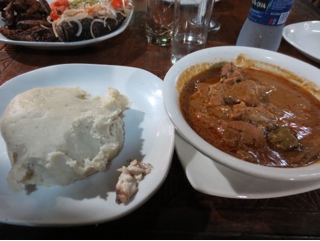
In Accra, I also had my first encounter with West African cuisine when I tried banku with groundnut (aka peanut) stew (see photo below). Banku is a gooey mixture of fermented corn and cassava, which is often served with some sort of stew. In theory, to eat like a true Ghanaian, you should eat this with your hands--pulling a piece off with your fingers, making an indention with your thumb and then using it to scoop up some stew. In practice, I felt like I was using sticky, sour mashed potatoes (or maybe Playdoh) as an edible utensil for spicy peanut soup. Filling as it is, banku is not something I will be seeking out, though I have a feeling it (or its close relative fufu) will find me again in these next 10 days...

Apologies that these photos aren't within the text (& seem to be all out of order). I know it'd probably be easier to follow, but I'm new to blogging and trying to do it on an iPad with often-spotty Internet hasn't been the easiest. Bear with me (& hopefully you can figure out what goes with what)!

Saturday, July 14, 2012

Adventures in Accra ("ah-KRAH")

Sorry for the delay in posting... We arrived Thursday night and have been slowly but surely figuring things out and navigating the city. It has been interesting to see Accra, Ghana's capital and largest city. In some ways, Accra seems like it could be a big city in any developing nation--lots of street vendors (except you should see how much these women can carry on their heads! Will try to include a pic later...it's impressive to say the least!), fairly inefficient systems (had to return to airport yesterday to pay for a flight. Long story short, it took 3+ hours and we still almost didn't get it done!), some questionable transportation options, and many many winding roads with no names to be found. It's certainly not the easiest of cities to navigate, but we are finding our way and learning as quickly as we can.

Today was a particularly exciting day, as I made some great progress towards my goal of deepening my knowledge of Ghanaian art. Today, I had the opportunity to meet with Ablade Glover, a prominent and well-respected Ghanaian painter and retired university professor (see photos of us below, along with a few examples of his paintings). He provided insight into Ghanaian fine art, well beyond the traditional arts that Americans tend to think of when thinking of African art. Professor Glover now runs The Artists Alliance Gallery, one of the few fine art galleries in the country. He opened the gallery with the vision of bringing contemporary African art into the international art scene. The painting styles were quite varied, and it opened my eyes to some incredibly talented Ghanaian artists. It's hard to believe so little is known of most of them outside of Ghana. I was able to purchase several catalogues of art from past exhibits so I can share these wonderful artists with my Suder students and friends. I also had a chance to visit the Loom Gallery, the country's oldest art gallery (opened about 45 years ago) and talk with the gallery's founder, Frances. She's an absolutely lovely woman who was a wealth of knowledge about West African art in general.

More later, but now it's time to sleep! We will be getting up early to catch the bus to Cape Coast (...although there is no published schedule that we can find, so wish us luck!)